
That desperate search led me down a rabbit hole of ergonomic specifications, warranty fine print, and conflicting reviews that made my head spin faster than my old chair’s squeaky wheels.
Choosing between Branch and its competitors requires understanding what truly matters for your body, budget, and work habits, so you feel confident in your decision. Comparing features on paper can make you feel uncertain about how a chair will support you after hours of work.
I’ve tested enough chairs to know that the $1,900 Herman Miller sitting in my friend’s corner office doesn’t automatically make him more comfortable than I am in my mid-range Branch. But I’ve also learned that the cheapest option rarely saves you money when you have to replace it 18 months later with another cheap chair that will fail just as quickly.
Branch occupies this particular sweet spot in the market. They aren’t trying to be the budget option, and they’re definitely not positioning themselves as a luxury brand.
Listen to an audio brief:
Why the Office Chair Market Is More Complicated Than You Think

The office furniture industry operates on a completely different set of economics than most consumer products. Premium brands like Herman Miller and Steelcase built their reputations over decades by selling to corporations with procurement budgets and purchasing managers who valued durability over initial cost.
A $1,200 chair that lasts fifteen years in a corporate environment actually costs less per year than a $300 chair that needs replacing every three years. The math is straightforward when you’re a facilities manager buying fifty chairs at once with a long-term budget to manage.
But the work-from-home explosion completely disrupted that model. Suddenly, millions of people were making purchasing decisions with their own money instead of corporate budgets.
They needed genuinely good ergonomics because they were sitting for eight to ten hours daily. Still, they didn’t have procurement departments negotiating bulk discounts or the ability to expense a $1,500 chair without getting serious questions from accounting.
This created an opening for brands like Branch, Vari, Flexispot, and dozens of others to enter the market with a different value proposition entirely. They could skip the retailer markups, reduce the customization options to what most people actually need, and deliver genuinely ergonomic chairs at prices that people could justify.
Branch recognized something really important about this new buyer. You’re not looking for the cheapest option, because you’ve probably already learned that cheap furniture falls apart or causes physical problems.
But you’re also not convinced that spending two months’ rent on a chair is necessary to avoid back pain. You want reassurance that the middle ground exists-that you can get genuine ergonomic benefits without overspending.
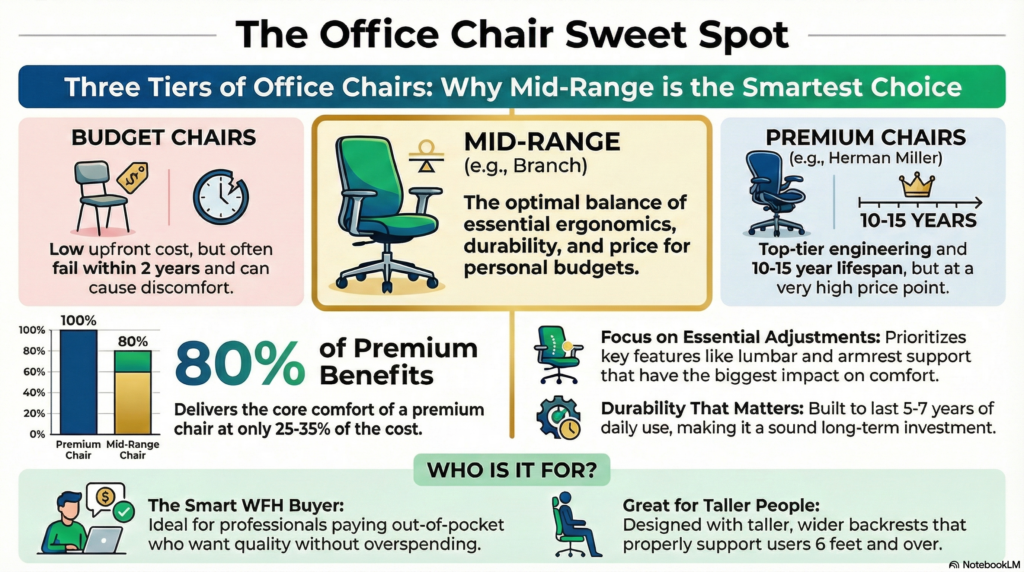
The challenge in comparing Branch to competitors is that you’re really comparing three distinct product categories that compete for the same spot in your home office. Budget brands prioritize low prices above everything else.
Premium brands prioritize engineering and longevity.
Mid-market brands like Branch select the most critical features from premium chairs while keeping costs manageable through direct-to-consumer sales and simplified customization options, empowering you to choose a chair that fits your needs without feeling overwhelmed by choices.
What Actually Differentiates Office Chair Brands
When I first started researching chairs, I made the mistake of thinking that comfort was the primary differentiator. Comfort is subjective, highly dependent on your body type, and surprisingly not always correlated with price.
I’ve sat in $200 chairs that felt amazing for the first hour and terrible by hour three. I’ve sat in $1,500 chairs that impressed me with their engineering but never quite felt natural for my body shape.
Initial comfort means almost nothing compared to how a chair supports you during extended use.
When comparing office chairs, consider how the adjustability range, material quality, and ergonomic design philosophy actually support your body during extended work sessions. Understanding these factors helps you move beyond marketing claims and choose a chair that genuinely addresses your ergonomic needs.
Branch’s approach to adjustability focuses on the adjustments that actually matter to most users, rather than competing with premium brands on sheer number of adjustment points. The Vari Essential Task Chair advertises nine separate adjustments, which initially sounds impressive.
But Branch made a calculated decision to include the adjustments that genuinely impact your sitting experience throughout a full workday.
Their lumbar support adjusts in ways that actually change your spine position. Their armrests move in the directions that prevent shoulder tension.
They skipped some of the minor adjustments that look good in marketing materials but don’t meaningfully change how you sit or how your body feels after eight hours.
This philosophy is clear when you compare the Branch Ergonomic Chair to something like the Steelcase Leap. The Leap has four-way adjustable arms that can move in, out, forward, backward, up, down, and pivot.
The engineering is genuinely impressive, the kind of thing you want to show off to visitors.
But in practical daily use, most people set their armrests once and adjust them twice a year. Branch gives you height and width adjustment, covering probably 85% of real-world needs at a fraction of the cost.
You lose the ability to micro-adjust every possible dimension, but you keep the functionality that actually matters.
Material quality explains much of the price difference between brands. Premium brands use aluminum bases, high-grade steel mechanisms, and fabrics or meshes designed to last a decade of daily use without showing visible wear.
These materials cost substantially more, but they deliver longevity that justifies the investment if you’re keeping the chair long enough.
Branch uses quality materials while making calculated trade-offs. Some of their bases are reinforced with polyethylene rather than metal.
Their fabrics are durable, but not the same grade as what Steelcase specifies for commercial environments.
These choices let them hit their price point while still delivering chairs that should last 5 to 7 years of everyday use, which meets the needs of most home office workers.
Pay attention to warranty terms, as they indicate how confident a brand is in its product’s longevity. For example, branch offers five to seven years, which is generous for their price point, helping you assess whether the chair will last and be worth your investment over time.
Vari’s three to five years is more typical for budget-friendly options.
Steelcase goes up to twelve years because they’re confident their chairs will outlast that warranty period. Herman Miller varies by model, but generally expects its chairs to last 10 to 15 years.
Branch’s warranty only applies if you purchase directly from them or activate it within seven days of an Amazon purchase. I almost missed this detail, and it would have been a costly mistake.
If you buy through a third-party retailer and forget to register, you’re essentially unprotected after the return window closes.
This matters more than people realize when they’re comparing prices across different retailers.
How Branch Actually Compares to Specific Competitors
The Branch versus Vari comparison is probably the most relevant for budget-conscious buyers. These brands compete directly in the $230 to $550 range, and on paper, they look really similar.
Both sell direct-to-consumer.
Both emphasize reasonable prices without sacrificing all ergonomic features. Both require minimal assembly that you can handle yourself in ten to fifteen minutes.
The differences emerge when you actually sit in them for extended periods. Vari’s chairs tend to have slimmer, more rounded backrests that work really well if you have a narrower frame.
Branch deliberately designed wider, taller backrests that accommodate broader shoulders and taller torsos.
This isn’t just aesthetic preference. If you’re five foot ten or above, or if you have the shoulder width that comes from any upper body development, the Branch backrest will support you better throughout a full workday.
Your shoulders won’t hang off the sides of the backrest, and your upper back will actually contact the support surface.
Vari wins on pure adjustment granularity. If you’re someone who constantly shifts positions, who likes to fine-tune every angle throughout the day, Vari gives you more control points.
But most people set their chair up once, make seasonal adjustments when they switch from heavy sweaters to t-shirts, and otherwise leave it alone.
Branch optimized for that majority use case.
The price difference between comparable models is usually $40 to $80, with Branch costing more. That premium gets you better warranty coverage, more color and material options, and generally more substantial build quality.
Whether that’s worth it depends entirely on your priorities and your timeline.
If you’re buying a chair to last two to three years until you move or change your setup, Vari makes more sense. The lower upfront cost and adequate quality for shorter-term use make it the rational choice.
If you’re investing in something you expect to use daily for five to seven years, Branch’s durability advantage becomes more valuable than the initial savings.
Comparing Branch to Steelcase or Herman Miller feels almost unfair because you’re looking at such different price points. The Steelcase Leap starts around $619 and can exceed $1,300 with premium configurations.
The Herman Miller Embody typically runs $1,900.
These aren’t just more expensive chairs. They’re fundamentally different products built to different specifications for various use cases.
The Steelcase Leap’s LiveBack technology flexes with your spine movements in a way that feels genuinely different from static lumbar support. The Herman Miller Embody’s pixelated support system distributes pressure across your back in ways that cheaper chairs simply don’t attempt. These features aren’t marketing fluff.
They’re real engineering that you can feel during extended use.
The comfort difference between a $300 Branch and a $1,900 Herman Miller is not proportional to the price difference. You’re not getting six times more comfort.
For most users in typical work situations, you’re getting 15% to 25% more comfort and support, along with significantly better longevity and more robust mechanisms that will maintain their adjustability for years longer.
The value proposition shifts dramatically based on who’s paying. If your employer provides a work-from-home stipend that covers premium chairs, absolutely get the Steelcase or Herman Miller.
The superior longevity means you might never need to buy another chair.
If you’re paying out of pocket, Branch delivers enough ergonomic benefits that the massive price difference becomes really hard to justify unless you have specific medical needs.
Understanding Your Body’s Actual Requirements
Most comparison articles miss entirely the fundamental question of what your body actually needs from a chair. They focus on features and specifications without addressing whether those features solve your specific problems.
If you’re dealing with chronic lower back pain, lumbar support becomes essential as opposed to a nice-to-have feature. But not all lumbar support is created equal.
Some chairs have fixed lumbar curves built into the backrest.
Others have adjustable lumbar pads that you can raise or lower. The most sophisticated systems, like what Steelcase offers, have lumbar support that moves with you dynamically as you shift positions.
Branch’s adjustable lumbar support is genuinely adequate for most back pain scenarios. You can move it up or down to match your spine’s curve, and the pressure it provides is firm enough to maintain your posture without feeling intrusive.
The adjustment mechanism is simple enough to fine-tune throughout the day if your needs change.
The system isn’t as sophisticated as Steelcase’s LiveLumbar, but it addresses the core problem for 80% of users with back issues.
If you’re tall, like legitimately six feet or taller, chair fit becomes much more critical than any other factor. Standard office chairs are designed for average-height users, which means the backrest often doesn’t extend high enough to support your whole spine.
Your shoulders end up above the backrest, which forces you to slouch to get any back support at all.
Branch deliberately designed their Task Chair with a taller, wider backrest specifically to address this common complaint. The extra height means your entire spine makes contact with the support surface, and your shoulders don’t hang unsupported. It’s one of the few sub-$300 chairs that actually works well for taller users without forcing you up into the premium price brackets where taller models become standard.
Body weight and build matter more than most marketing thanks. Branch chairs typically have a 275-pound weight capacity, which is standard for mid-range furniture.
If you’re approaching or exceeding that limit, you should look carefully at weight specifications and consider chairs with reinforced bases.
Herman Miller and Steelcase generally rate to 300 to 350 pounds with more robust mechanisms that handle the load better long-term.
Shoulder width impacts armrest functionality in ways that aren’t obvious until you actually sit down. If you have broader shoulders from athletic development or just your natural build, armrests that are too narrow force your arms inward, creating tension in your shoulders and neck.
Branch’s armrests have enough width adjustment to accommodate broader builds, while Vari’s slimmer design sometimes creates this problem for larger users.
The Real Cost of Making the Wrong Choice
I want to talk about something most reviews ignore completely: the hidden cost of making a poor choice. When I first started working from home, I bought a $150 chair from a big box retailer because I thought I was being financially responsible.
Within six months, the cushion had compressed to nothing, the arms wobbled, and my lower back hurt every afternoon.
I replaced it with a slightly better $220 chair. That one lasted about 18 months before the gas lift began to fail and the mesh backrest developed a permanent sag at the point where my spine rested. At that point, I’d spent $370 on chairs that lasted less than two years combined, and I’d dealt with physical discomfort the entire time.
When I finally invested in a proper mid-range chair, the immediate difference was noticeable. But the long-term value was even more significant.
Three years later, that chair still functions precisely as it did on day one.
The cushion maintains its support. The adjustments still hold position without slipping.
I haven’t had the afternoon back pain that used to be routine.
This pattern plays out constantly with office furniture. Cheap chairs seem like smart budgeting until you factor in replacement costs and the productivity loss from physical discomfort.
Working with persistent back or neck pain doesn’t just hurt.
It makes you measurably less effective at cognitive work. You’re distracted by discomfort.
You take more breaks.
You end the day exhausted in ways that go beyond normal work fatigue.
Branch sits in the zone where you’re spending enough to get genuine quality without entering the premium pricing that’s really only justifiable for extreme use cases or when someone else is paying. The $279 to $550 range isn’t impulse purchase territory, but most working professionals can justify the investment without significant financial stress.
Making the Decision for Your Specific Situation
If you’re a remote tech professional earning a decent income but still price-conscious, Branch’s Ergonomic Chair, priced at $299 to $399, is probably your best option. It delivers the ergonomic features that actually matter without requiring you to rationalize spending two months of your home office budget on a single piece of furniture.
If you’re a freelancer with inconsistent income, Vari’s lower price point might be more practical, even though you’re sacrificing some durability and customization. The $60 to $80 you save can be meaningful when your monthly income varies.
Accept that you’ll probably replace it sooner and factor that into your long-term planning.
If you have a work-from-home stipend from your employer that covers premium furniture, seriously consider Steelcase Leap or Herman Miller. When someone else is paying, the value calculation shifts completely.
The superior longevity and more sophisticated ergonomics become free upgrades rather than expensive luxuries.
If you have diagnosed chronic pain conditions, the conversation changes entirely. Talk to your healthcare provider about whether premium ergonomic seating might be partially covered as durable medical equipment.
Some insurance plans will cover portions of ergonomic furniture with proper documentation.
At that point, Herman Miller or Steelcase becomes more accessible, and their superior ergonomics might genuinely improve your condition in ways that justify the investment.
If you’re tall, like 6 feet or above, the Branch Task Chair is one of the few sub-$300 options that will actually fit your body correctly. Most budget chairs will leave your upper back and shoulders unsupported, which defeats the entire purpose of ergonomic seating.
People Also Asked
Is Branch a good office chair brand?
Branch makes solid mid-range office chairs that deliver good ergonomic features at reasonable prices. Their chairs typically last five to seven years with regular use, which is respectable for the price point.
The build quality isn’t premium-level, but they use decent materials and offer better warranties than most competitors in their price range.
How long do Branch office chairs last?
Most Branch chairs last five to seven years with regular daily use. The warranty coverage reflects this expected lifespan, with most models covered for five to seven years.
Premium brands like Steelcase often last 10 to 15 years, but Branch chairs should handle a typical work-from-home setup without major issues for at least half a decade.
What office chair do chiropractors recommend?
Chiropractors typically recommend chairs with adjustable lumbar support, seat depth adjustment, and properly positioned armrests. Brands often mentioned include Herman Miller, Steelcase, and Ergohuman.
Branch chairs with adjustable lumbar support meet many of the same criteria at lower price points, making them suitable choices for most people without specific medical conditions.
Are expensive office chairs worth it?
Premium office chairs are worth the investment if you’re sitting for long hours daily, have chronic pain issues, or receive employer reimbursement. For most people paying out of pocket, mid-range chairs like Branch deliver 80% to 85% of the benefits at 25% to 35% of the cost.
The marginal improvement from premium chairs doesn’t justify the price difference unless you have specific needs.
Which is better, Branch or Herman Miller?
Herman Miller chairs offer superior engineering, longer lifespan, and more sophisticated adjustment mechanisms. Branch offers solid ergonomics at a much lower price point.
Herman Miller makes sense when someone else is paying, or you need maximum longevity.
Branch makes more sense for typical home office use when you’re paying yourself.
Do office chairs help with back pain?
Quality office chairs with proper lumbar support significantly reduce back pain for most people. The lumbar support maintains your spine’s natural curve, reducing strain on lower back muscles.
Cheap chairs without adjustable support often make back pain worse by forcing poor posture.
Investing in decent ergonomic seating usually provides noticeable pain reduction within a few weeks.
How much should I spend on an office chair?
Most people should budget $300 to $500 for an office chair if they work from home regularly. This range gets you genuine ergonomic features and reasonable durability without paying for premium brand names.
Spending less usually means replacing the chair sooner.
Spending more provides marginal improvements unless you have specific medical needs.
Key Takeaways
Branch delivers about 80% to 85% of premium chair comfort and ergonomics at 25% to 35% of the premium price, making it the optimal value choice for most buyers paying out of pocket.
The difference between Branch and budget choices like Vari is meaningful enough to justify the $40 to $80 price premium if you plan to keep the chair for five-plus years, primarily because of superior warranty coverage and more durable construction.
Premium brands like Steelcase and Herman Miller are only worth the massive price jump if someone else is paying, you have specific medical needs that require their advanced features, or you’re committed to keeping the chair for ten-plus years. You can amortize the cost over that extended period.
Your body type, height, and specific pain points matter far more than any brand comparison when choosing the right chair, so prioritize models that address your particular physical requirements over general reputation or reviews from people with bodies entirely different from yours.
Download our WFH Chair Buyer’s Guide: